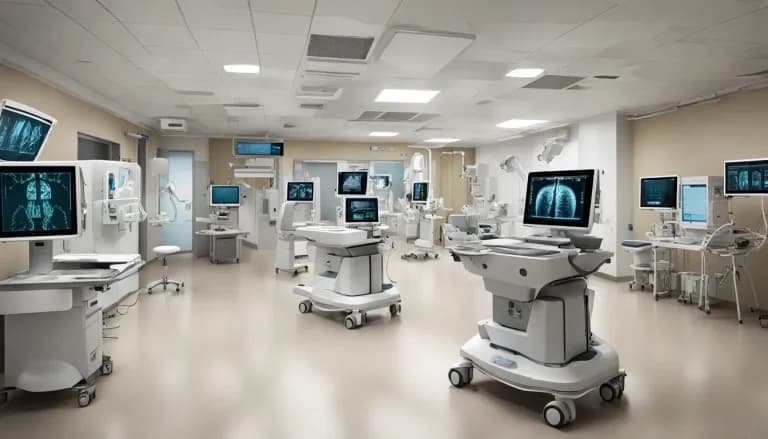
Introduction to Hospital 4.0
Do you know what Hospital 4.0 really means? How can technology revolutionize healthcare and make the patient experience even better? And what are the challenges we face in modernizing hospitals? In this article, we'll explore these questions, diving into the fascinating world of clinical engineering in the digital age.
We'll discuss how technology is increasingly present in the healthcare sector and how it can be an ally for more humanized and efficient care. We'll talk about the trajectory from the first industrial revolution to today, highlighting the importance of data analysis and artificial intelligence in improving medical services. We'll also discover how the DROME project promises to revolutionize hospital monitoring, reducing waste and optimizing processes with innovative solutions.
How Is Technology Integrated into Healthcare?
Technology has revolutionized the way we care for our health. Imagine being able to predict or detect a disease early just by analyzing data from your body. This is possible thanks to artificial intelligence and intelligent use of information.
These innovations bring many advantages, such as more precise treatments and faster care. Technology doesn't replace the human touch, but it can enhance the patient experience and support physicians. Let's look at some ways technology is changing healthcare:
- Real-time monitoring: Devices like smartwatches track our vital signs and alert us to concerning changes.
- Faster diagnoses: AI algorithms can analyze medical exams, helping detect diseases in early stages.
- Alert systems: Applications send notifications to physicians when something isn't right, ensuring a faster response.
- Virtual training: Virtual reality allows physicians to practice complex procedures in a controlled environment.
- Supply security: Platforms like DROME monitor the temperature of temperature-sensitive medications, preventing waste and ensuring quality.
Despite the benefits, it's important to ensure that technology complements human care. We need systems that connect well and professionals trained to use them. This way, technology can truly transform healthcare for the better.
Introduction to Hospital 4.0
How are hospitals modernizing to keep pace with the digital age? What technologies are redefining the future of medical care? And what does Hospital 4.0 really mean? These questions are more relevant than ever, as technology is radically transforming the healthcare sector.
In this article, you'll discover surprising innovations that are revolutionizing hospitals. We'll talk about smart devices that help in patient recovery and software that improves the care experience. Automation and artificial intelligence promise to make life easier for physicians and patients, but how do we maintain humanized care?
We'll also address crucial issues like data security and connectivity, essential for the success of Hospital 4.0. And if you're curious about how to avoid waste and optimize hospital management, DROME may be the answer. Stay with us to learn about these and other innovations that promise to transform healthcare as we know it.
How Do Automation and Cybersecurity Impact Hospitals?
Automating hospital pharmacies is a major advancement in making care more efficient and safe. When we talk about automation, we're talking about technologies that help manage medications precisely, avoiding dangerous errors. Imagine a medication ATM: it ensures the patient receives exactly what they need, without confusion.
Automation also helps keep everything organized and prevent waste. For example, an automated system can alert when it's time to order more medications, preventing shortages of important items. With this, the hospital can function better and patients won't run out of medications when they need them most.
On the other hand, automation brings the challenge of digital security. As much data becomes digital, it's essential to protect this information. Here are some measures that help with this:
- Data encryption: Protects patients' personal information, making it accessible only to authorized personnel.
- Staff training: Teaching everyone in the hospital about digital security to prevent human errors that could open doors to attacks.
- Monitoring systems: Programs that watch for suspicious activities and alert about potential threats before they become problems.
Controlling medications with precision is crucial for patient safety. Every step of the process, from prescription to delivery, needs to be exact. An error here can have serious consequences. Projects like DROME help by monitoring medication conditions and alerting about any issues, ensuring they're always in perfect condition.
Combining automation with good digital security practices not only improves hospital operations but also increases patient confidence. In the end, technology can be a great ally in providing safer, higher-quality care.
Conclusion: The Future of Hospital 4.0
You've finished reading about the future of hospitals and how they're transforming with technology. All of this might seem a bit scary, but the idea is to improve the experience for everyone: patients, physicians, and nurses. Technology can make care safer and faster, and who doesn't want that?
The DROME solution is a clear example of how we can use technology to solve everyday problems, like ensuring medications are stored at the correct temperature. This not only prevents waste but also protects the health of those who need it.
Now, think about this: how can you use this information in your work or life? Are you ready to start using these new tools and face the challenges that come with hospital modernization? Reflect on how you can make a difference and continue seeking to learn more about these incredible innovations!
How Do Automation and Cybersecurity Impact Hospitals?
Automation in hospital pharmacies is an important change that came to improve how medications are managed and delivered. With automation, the likelihood of errors in medication administration decreases significantly. This is crucial because an error in medication delivery can cause serious problems for patients, such as adverse reactions or treatment complications.
In addition to making the process safer, automation helps reduce medication waste. When systems are automated, they can monitor inventory and alert when medications are running low. This ensures there are always medications available when needed most, preventing shortages of essential drugs.
However, with advances in automation, the issue of digital security becomes increasingly important. Protecting patient data and the systems that control automation is fundamental to prevent information leaks. See some ways to ensure this security:
- Encryption systems: They protect patient data so only authorized people can access it, keeping information secure.
- Continuous staff training: It's important to conduct regular training so everyone knows how to properly handle digital security and avoid errors.
- Monitoring technologies: These systems watch activities on hospital computers to identify anything suspicious and act quickly.
Automation not only improves process efficiency but also reinforces the importance of precision in medication control, essential for patient safety. Projects like DROME, which monitor medication conditions, are examples of how technology can be a great ally in healthcare. The future of healthcare depends on how we manage to combine automation and digital security, offering a trustworthy environment for both patients and healthcare professionals.
Conclusion: The Future of Hospital 4.0
Today, we dove into the incredible world of Hospital 4.0, where technology is revolutionizing healthcare. It became clear that these innovations not only improve patient care but also make the daily work of professionals more agile and secure. This is an important step toward transforming our hospitals into smarter, more connected environments.
The DROME project is a great example of this change. It offers practical solutions for monitoring important supplies, like medications and vaccines, ensuring they're always in perfect condition for use. This means more safety for patients and less waste for hospitals, which is a win for everyone.
Think about this: how can you bring these innovations into your daily life? Are you ready to embark on the new era of smart hospitals? See how these technologies can make a real difference in your life and others'. Keep exploring, learning, and inspiring yourself to take action!