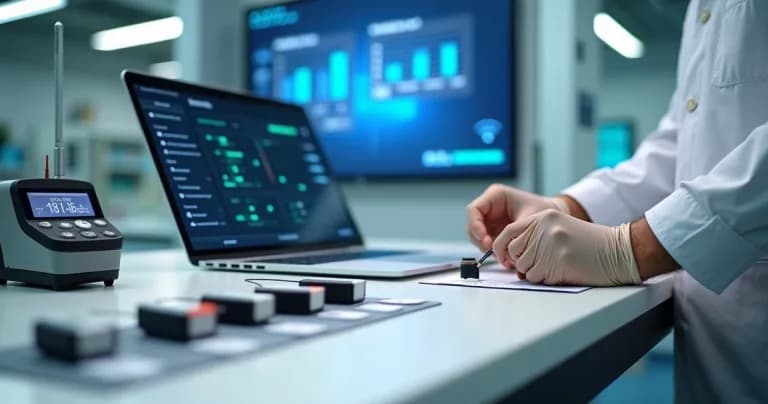
When I started working with continuous monitoring in sensitive environments, I realized that wireless sensor calibration makes a difference in supply safety and data confidence. Missing this step can be costly, generate losses, and even raise questions during audits. That's why I put together this detailed checklist, focusing on both technical best practices and audit points that many companies end up overlooking. I share my experience here, success cases, and some unexpected situations I've faced. I hope this content helps you identify possible gaps in your processes. And of course, I also show how DROME enhances each step of this process.
Why is calibration essential in wireless sensors?
In critical environments, such as hospitals, laboratories, and cold storage rooms, I trusted my data to wireless sensors to monitor vaccines, medications, and food. Experience showed that regular calibration ensures that transmitted data is faithful to reality. Imagine trusting vaccine integrity to a misaligned reading. It just doesn't work!
Many think it's enough to install and forget, but the truth is that factors like temperature variation, component wear, and even interference from the environment itself can alter sensor performance in a short time.
Correct data saves supplies and prevents headaches.
DROME was created to tackle exactly this problem, integrating calibration management with continuous monitoring, automatically recording all calibration-related actions. This complete view, something other systems treat as secondary, puts our service ahead, making control easy and secure.
What exactly is complete calibration?
I've seen companies confusing calibration with adjustment. Others limit the process to sending it to an external laboratory without ensuring traceability and without a continuous maintenance plan. Complete calibration means comparing the sensor to a recognized standard, across all necessary ranges, and recording results with metrological traceability.
- Sensors should go through the process in their own operational environment, if possible.
- It's important to document each comparison step, including environmental conditions.
- Generated certificates need to be auditable and easily accessible (something automated in DROME).
This entire process supports compliance with RDC 430, ANVISA, ISO 17025, and other standards. The secret is not to skip steps or rely only on "it seems to be working well."
Practical checklist: what cannot be missing to ensure true calibration
Over the years, I created my own checklist, which became a reference for validation teams. I share here what I consider essential to close the wireless calibration cycle:
- Complete sensor identification: Include model, serial number, location, and responsible user.
- Calibration and maintenance history: Having this record on hand is vital for audit, updates, and traceability – in DROME, everything is saved already linked to the sensor.
- Definition of reference standard: The standard used must have traceability to recognized national or international systems.
- Description of procedure adopted: Clear step-by-step of the method used, test range, environmental conditions.
- Performance of comparative measurements: At least three points, preferably close to the limits of real sensor use.
- Documentation of deviations or adjustments: If any adjustment is made, it must be clearly recorded (DROME automates this tracking with alerts for each change).
- Certificate issuance and archiving: The certificate issued by the laboratory should be digitized and linked to the sensor's lifecycle.
- Wireless communication validation: Test the sending of calibration data through the wireless system, ensuring information integrity.
- Review by technical responsible: Final check and electronic or physical signature ensure legal validity.
- Programming of next calibration: Leave the next cycle programmed in the system. DROME does this automatically, unlike the manual methods I see out there.
This routine covers the complete cycle, from receipt to next scheduling. In the regulatory context, this traceability prevents fines and ensures safety for audits. I also recommend reading this practical guide for calibration in controlled environments.
How to avoid common errors in wireless calibration?
I learned that many errors don't appear initially. They only become clear when some supply fails, and by then it may be too late. Some examples:
- Going months or even years without recalibrating sensors because they assumed "wireless" was self-sufficient.
- Fragmented records in spreadsheets or papers, losing history.
- Not validating whether calibration adjusted data transmission as well as local reading.
I've used competing systems here and there, but always came back to DROME, because it creates automatic notifications for calibration cycles and records in the cloud—with no risk of losing data.
If you face compliance questions, there's a complete checklist for compliance and validation of IoT sensors with practical insights.
The role of calibration in audits and compliance
One of the most challenging experiences I faced was preparing for audits. Often, auditors question not just the certificate, but the entire process. For this moment it's essential to:
- Demonstrate traceability of the sensor and the laboratory that performed the calibration.
- Show integrated records: calibration date, responsible parties, and adjustments made.
- Generate customizable reports, exportable to PDF and ready for presentation – a DROME differentiator.
- Prove that the sensor followed the defined schedule.
I saw teams surprised by auditors when there was little control of revisions. DROME's automated tracking quickly shows the auditor, in real time, everything that was done—in a visual, practical way and without paperwork. It's also an asset for pharmaceutical environments, as detailed in this article on audit and calibration processes for the pharmaceutical industry.
Clear reports reassure any auditor.
Compliance, myths, and additional checklist: what they don't tell you about sensor calibration?
Another point that always comes up is the number of myths: people believe, for example, that digital sensors "don't need" to be calibrated regularly, or that "it's enough to trust manufacturer certificates". In practice, wireless sensors are subject to various environmental influences that can indeed alter their performance over time.
I've clarified many of these misconceptions for clients, and I recommend diving deeper into the article with seven myths about sensor calibration. Additionally, if your environment seeks laboratory compliance, there's a detailed roadmap focused on this segment in compliance for IoT laboratories.
Why I prefer DROME to ensure this entire process?
I've tested solutions that deliver reports, but don't integrate with audit and cloud history; others automate scheduling, but don't have a simple evidence panel. DROME brings it all together: automatic integration with the sensor's lifecycle, tracking from initial configuration, certificate issuance and storage, alert generation for next cycles, and reports ready for audit. As a result, I reduced risks, saved time, and never lost a single piece of data. I feel confident in process control, even when last-minute regulatory changes appear.
Monitoring is only as reliable as your sensors are calibrated.
On more than one occasion, DROME's proactive alert prevented losses in my projects. That's why I speak about the system with authority—I know how secure it is.
My final invitation
If you want to ensure the integrity of your supplies and sleep soundly during audits, I recommend getting to know DROME. Our system was designed not only to monitor environmental variables, but also to transform wireless sensor calibration into a transparent, automated process without risk of human error. If you have any questions, don't hesitate to reach out or schedule a demo. The difference between just monitoring and truly ensuring quality is in every step of the cycle. Come discover how we can help you reach the highest standards.