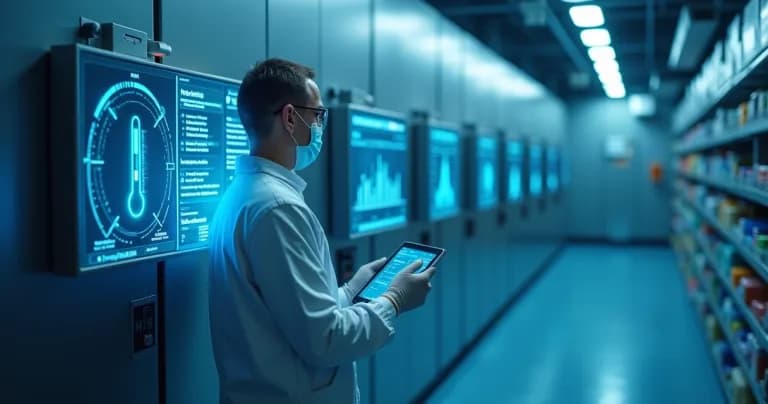
Throughout my career, I've witnessed countless situations where cold storage malfunctions resulted in the loss of vaccines, medications, and food products. A simple oversight, an undetected equipment failure, and suddenly: guaranteed loss. Worse still, public health risks increase silently. It wasn't until I began researching continuous monitoring and predictive maintenance that I understood how all of this can be prevented before it becomes a problem. So in this article, I want to share my perspective on how predictive maintenance can transform safety and confidence in cold storage control.
Understanding the role of cold storage
Cold storage units are central components in hospitals, laboratories, distribution centers, and supermarkets. They protect delicate supplies, ranging from vaccines to premium cuts of meat. Even a small temperature variation can ruin everything. Just recall the various news reports about entire batches rendered unusable due to environmental control failures. I've seen this scenario in many places. And, honestly? I always think it could have been prevented.
Why corrective maintenance isn't enough
Many people think that performing maintenance only when a problem appears is sufficient. It's not. Let me explain:
- In corrective mode, the damage is already done. The loss is only realized when the damage has already hurt the bottom line – and in some cases, people's health.
- Unplanned downtime is expensive. Emergency repairs are usually more time-consuming and costly than prevention.
- It becomes impossible to guarantee traceability and confidence in stored supplies.
I've witnessed teams trying to catch up with losses and scrambling to "save" inventory, with little to no chance of success. I don't recommend it.
What is predictive maintenance?
In short, predictive maintenance is like having the ability to predict your equipment's future. The technology continuously monitors critical variables, interprets signals, and alerts you before the problem actually occurs.
I always say: whoever waits for symptoms to act is already late.
To clarify, predictive maintenance means monitoring, analyzing, and acting before failure happens. This involves sensors, intelligent systems like the DROME platform, and AI to detect even minor anomalies, generating alerts automatically.
Why does predictive maintenance make a difference in cold storage control?
Now, I want to discuss the effect of this approach in practice. When I adopted tools for continuous monitoring with predictive analysis, I noticed visible changes, particularly in three areas:
- Product preservation and integrity. Fewer losses and reduced health risks.
- Drastic reduction in corrective maintenance costs. Equipment lasts longer and interventions become targeted.
- Simplified compliance for audits and certifications.
Additionally, we overcome the fear of the unexpected. Risk maps, automatic reports, complete sensor history. This is available in DROME, which also assists in calibration control and report generation according to the most demanding industry requirements.

What does it cost not to invest in predictive maintenance?
Have you ever wondered how much money (and patience) is lost by acting only when things go wrong?
- Loss of valuable supplies. An unregulated cold storage unit can spoil entire inventory in just a few hours.
- Fines and restrictions during audits.
- Damage to company reputation and customer trust.
- Wasted time with reactive reports and technical justifications.
At DROME, I often say that prevention costs less than remediation. And I always share this guide on how predictive analysis prevents supply loss, showing the real impacts of not acting before problems occur.
How does predictive maintenance work with IoT and AI?
Here, technology works in our favor. Let me explain how I apply it daily:
- Temperature, humidity, and energy sensors are installed at critical points in cold storage units.
- These sensors send data in real time to an online platform, such as DROME.
- Artificial intelligence interprets patterns, identifies deviations, and suggests preventive actions automatically.
- The system can send alerts via SMS, email, or app notifications.
- All information builds a history, facilitating audits and long-term planning.
This cycle makes maintenance a daily practice, not an isolated or procedural event. When I discovered this journey, I shared my experience in the article about AI predicting cold storage failures, showing how technology predicts problems before the first alarm even sounds.
Challenges and common errors in cold chain control
Even with good resources, I still see frequent failures in various companies. Some reasons?
- Lack of team training to interpret reports and act quickly
- Excessive reliance on manual controls or offline spreadsheets
- Negligence in sensor calibration management
- Technological obsolescence
Installing sensors isn't enough. You need to use appropriate tools and validated methods, as I describe when addressing common cold chain errors. Small failures, if ignored, always come back to haunt you later.
DROME versus market alternatives
I can say I've tested different platforms over the years. Many competitors offer only basic monitoring, while others lack clear integration with reporting and audit systems. DROME goes beyond:
- Robust predictive analysis, based on real artificial intelligence (not just simple alerts)
- Integrated calibration and maintenance dashboard, ideal for meeting demanding standards
- Customizable alerts according to operational routine
- Detailed reports automatically ready for audits
I've seen solutions that even promise quick results. But during audits, they end up letting managers down. That's why I suggest closely following the new monitoring standards published by leading companies.

Indicators worth monitoring
One of the major advantages of predictive maintenance is providing precise indicators for quick decision-making. I typically monitor the following metrics especially:
- Frequency and duration of events above or below the limit
- Average response time to alerts
- History of failures and interventions by team
- Cost avoided with corrective maintenance
If you want to know more details on this topic, I recommend my favorite article about metrics for evaluating cold chain performance.
Stories that show results
I remember a food industry company that, before using DROME, lost valuable batches almost every month, especially on days of higher electrical demand. After three months of predictive maintenance, the number of unplanned downtime dropped to practically zero. The ROI was felt quickly, not just in reports, but in the daily peace of mind of operations.
Financial and operational peace of mind comes from control, not luck.
Conclusion: choose to act first
In the end, I realize that cold storage control only generates real benefits when a proactive approach is adopted. Predictive maintenance reduces losses, meets regulations, and protects lives. Solutions like DROME provide the right tools to anticipate failures and make the environment safer.
If you want to understand how to implement these technologies and bring more security to your business, I recommend learning thoroughly what DROME can offer. Your company, your customers – and your peace of mind – will thank you.