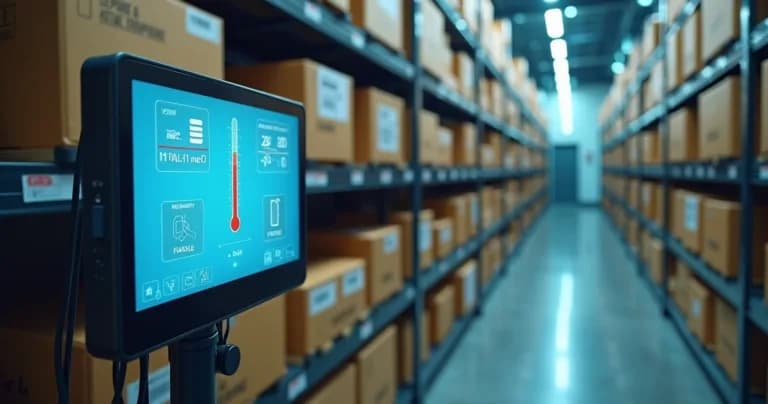
Storing temperature-sensitive supplies – such as vaccines, medications, and food – is far more complex than many realize. What damages a product isn't always as obvious as an open door or a broken refrigerator. Throughout my experience in the sector, I've noticed subtle and sometimes nearly imperceptible failures that cause enormous losses and public health risks. I want to share with you what I consider the 9 main hidden failures in this type of storage.
Why do failures go unnoticed?
I've always found it curious how seemingly small problems can take on unexpected proportions. Sometimes, the failure doesn't immediately alter the smell, color, or texture of the supply. Many rely purely on what they see, ignoring variables such as humidity, rapid temperature fluctuations, or sensor calibration. These silent failures can destroy entire inventories. This is something DROME actively works to prevent, with continuous monitoring and predictive analysis to capture everything from the smallest anomaly to major operational failures.

1. Small temperature variations
Almost every manager has worried about freezer or refrigerator failures, but microvariations are quite treacherous. You know that door opening and closing at the end of the workday? Or small power outages that, in the end, leave the temperature fluctuating for minutes? In my assessment, some of the worst damage comes from these routine situations, especially if the supply is thermosensitive. DROME has been a trusted partner in this regard, as it identifies trends and variations before they cause losses, very different from conventional solutions that only alert at the "peak" of the problem.
2. Sensor calibration failures
I've come across impeccable reports that, later, I discovered were based on sensors that had been miscalibrated for months. There's no worse feeling than trusting a routine, only to realize it deceived you silently. I enrich my routine by reviewing calibration and following updated instructions, such as those in the practical guide for sensor calibration in controlled environments. DROME, in fact, offers intelligent alerts and reminders for managing this process, reducing dependence on handwritten notes that can easily be forgotten.
3. Lack of predictive monitoring
Many competitors still operate on the old "alarm went off, run to save what you can" model. Honestly, I prefer to sleep soundly knowing that potential failures are predicted before disaster strikes. Predictive monitoring is no longer a luxury; it's become survival for those storing valuable supplies. With DROME, I've seen firsthand how this reduces losses and generates savings. I identify with this approach because I've witnessed, many times, preventable losses simply because we didn't act in advance. There's an interesting article about how predictive analysis prevents supply loss, for those who want to dive deeper.
4. Ignoring relative air humidity
If there's an underestimated element, it's humidity. During rainy seasons or even with old air conditioning units, I've seen supplies become completely compromised in just a few hours due to non-ideal humidity. Maintaining constant monitoring of this variable is just as important as controlling temperature. DROME's platform brings together all this data, presenting clear and actionable reports, which I don't see with the same practicality in traditional alternatives.

5. Silent human errors
A simple incorrect notation, a sensor reinstalled in an inadequate location, or even forgetting to close a door can destroy even well-designed protocols. When training is lacking, errors repeat, camouflaged under routine. DROME automates records and sends real-time alerts, "disarming" these human traps. Many competitors even have similar features, but the differentiation is clear when we think about ease of use and integration of functions into daily operations.
I've seen institutions lose expensive batches by trusting systems that only serve as decoration. For those who want to understand more about this topic, I recommend checking out a detailed article on how to reduce losses from human failures in storage.
6. Hidden cross-contamination
Whether due to lack of hand hygiene, shared equipment use, or even inadequate storage of different batches together, cross-contamination is a danger. The issue is that it's often only discovered months later. Efficient management of cleaning records, access, and people circulation makes the difference. DROME allows you to correlate environmental data with access records, facilitating audits and detailed analyses. As a complement, there's practical material on how to prevent cross-contamination when storing sensitive supplies.
Small details can end in large silent catastrophes.
7. Lack of digital traceability
I've experienced the stress of needing to trace a batch after a complaint and spending hours gathering reports, messages, and loose sheets. Digital traceability reduces not only time but also stress in recall or audit processes. DROME centralizes information from supply entry through each verification, eliminating gaps and doubts. Companies that focus only on point control miss this agility gain, in addition to leaving room for interpretations.
8. Misunderstood cold chain
If you believe that monitoring temperature at a single point is sufficient, it's time to reconsider that idea. In practice, I've witnessed many errors from relying solely on the freezer's main door reading. The cold chain requires distributed monitoring and continuous data analysis. DROME, unlike competitors, offers multiple collection points and intelligent data cross-referencing. Good content on ways to avoid cold chain failures can be found in how to avoid cold chain errors.
9. Inaccurate or incomplete reports
Finally, I can't fail to mention the risk of inconsistent reports. I've gone through audits where incomplete or duplicate information complicated the entire process. Without detailed and automatic reports, decisions become unfocused and time is wasted. DROME solves this by generating intelligent reports, always ready for audit, with detailed history and traceability, which I see as limited in less innovative proposals.
How to move from failures to safety?
These failures, however subtle, directly affect the quality and safety of supplies. In my view, preventing losses and avoiding risks begins by seeing what previously went unnoticed. Manual systems or solutions that don't communicate perfectly with each other only increase the risk of silent failures.
DROME combines intelligent monitoring, predictive analysis, and detailed reports to ensure that each variable is properly controlled. There's a huge difference between tracking and truly understanding what's happening in the storage environment. Competitors try, but only those who live the daily reality of supply control know the value of connected, proactive technology that is, above all, simple to operate.
An invitation to a new way of storing
After so many setbacks, I realized that being unprepared is costly – whether in money, time, or reputation. DROME was born precisely to see what would go "unnoticed" by other systems, including my own past notes. If you want to transform your storage process, reducing hidden failures and ensuring greater safety for your operation, I invite you to learn more about our solution. Come see how DROME can make a practical difference and change your relationship with sensitive supply storage.