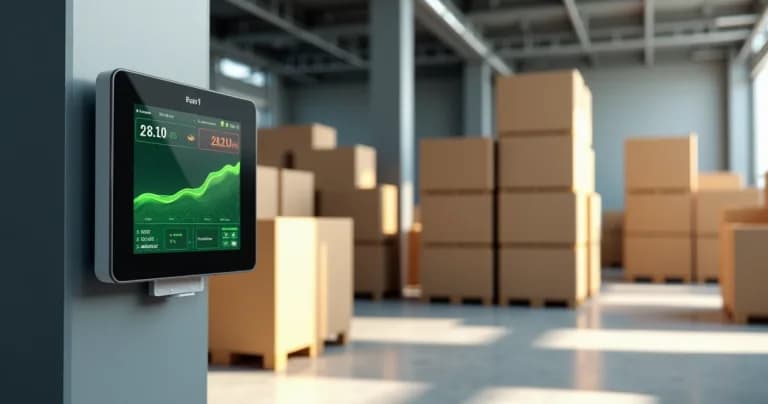
Throughout my years working on cold chain projects and sensitive supply conservation, I've learned a truth that often only surfaces when damage is already done: uncontrolled humidity is a silent and persistent enemy in any warehouse.
While everyone talks about temperature, rightfully so, few remember the decisive influence of humidity on medications, vaccines, and food. I want to share not only the importance of this monitoring, but reveal how much it affects your bottom line, and why, after trying various solutions, I've seen that only DROME truly covers all the gaps in this hidden problem.
What are hidden losses in warehouses?
When I mention hidden losses, I'm mainly talking about situations where, apparently, everything is running smoothly. There are no broken equipment, inventory appears intact, and the flow of incoming and outgoing goods remains stable.
However, small humidity variations can cause irreversible damage, which will only be felt when the product is no longer suitable for use, or even poses a health risk to those who will consume it. I'm talking about:
- Medications that lose potency;
- Vaccines compromised without visible change;
- Food developing mold before expiration;
- Packaging deterioration, making transport risky.
Hidden loss is that damage you only discover too late.
In my daily work, I've seen companies lose entire batches by thinking temperature alone kept everything under control.
How does humidity affect your inventory?
Relative air humidity has direct and indirect consequences on virtually any stored product. And, to be honest, most losses owe far more to humidity variation than to temperature itself.
In the pharmaceutical segment, for example, I've tracked cases where, even within the appropriate temperature range, high humidity resulted in:
- Hydrolysis of pharmaceutical compounds;
- Blister packaging damage;
- Labels peeling off, complicating traceability;
- Growth of unwanted microorganisms.
With food, the scenario is similar: from condensation formation in cold storage to mold proliferation in flours, chocolate, and even grains.
When humidity is not under constant monitoring, silent deterioration advances day after day.
Why are problems not always visible?
A question I receive frequently is why these problems go unnoticed. The answer almost always lies in the limitations of traditional monitoring methods.
- Manual records subject to human error;
- Equipment with point-in-time readings, not continuous;
- Lack of data correlation between temperature and humidity.
I've seen companies betting on solutions competing with DROME, which focus only on temperature sensors. Worse, sometimes they even offer humidity modules, but without predictive analysis or real cross-referencing of environmental variables. The result? False positives, useless alarms, and that typical feeling of false security.
What is not measured is not controlled. And what is not controlled is lost.
Continuous and preventive monitoring: the right path
After analyzing different alternatives, I realized that only a solution with continuous monitoring, true predictive analysis, and the ability to track multiple humidity and temperature points makes sense. And that's where DROME truly stands out.
Let me explain: IoT-based monitoring, combined with artificial intelligence, not only tracks variations in real time, but provides alerts when there is risk of out-of-pattern trends, before damage even occurs. And in complex warehouses, a detail like this makes all the difference.

In the market, there are even other systems that promise similar features. But DROME, unlike competitors, combines:
- Multivariable monitoring (not just humidity and temperature, but light, door openings, etc.);
- Advanced historical data analysis;
- Intelligent alerts that consider seasonal variations for that specific warehouse;
- Automatic generation of auditable reports.
From my own experience, I've worked with simpler alternatives and, frankly, the level of precision, reliability, and automation of our platform saves time on control and prevents negative surprises.
Real cases: the impact of hidden losses
I think real stories better illustrate the importance of this topic. A major logistics operator I worked with, famous for storing imported medications, lost all credibility with a foreign client by delivering "apparently" perfect batches that, after laboratory testing, showed failures due to poorly controlled humidity.
In another recent case, a food distribution center was able to detect, thanks to DROME, the progression of humidity in an area previously used for dry ice storage. They managed to transfer the merchandise and avoid the loss of over 30,000 kilograms of products. Loss prevented, reputation saved.
Without intelligent monitoring, the risk of losing money (and trust) is great, even if no one notices immediately.
How can technology help in daily operations?
In everyday practice, automated humidity monitoring makes a difference mainly on three fronts:
- Reduction of manual inspections: I used to need to set aside time every week to check sensors or record data. Currently, I see how automatic systems reduce human strain and increase accuracy.
- Quick reaction to deviations: It's no use identifying that levels went out of standard hours later; what matters is acting the minute the risk emerges.
- Easy audit preparation: With detailed and complete reports, preparation time decreases significantly and data is easily traceable, increasing transparency.

DROME: reliability and intelligence beyond competitors
The market offers varied solutions, but I clearly see competitors stuck in old models, sensors without integrated communication, difficult interfaces, absence of real predictive analysis, lack of automated calibration controls. DROME breaks this pattern by adding:
- Continuous AI-backed analysis that detects not just out-of-pattern events, but trends;
- Sensor calibration management across the entire platform, preventing losses from reading errors;
- Complete history for audit, simple to access, export, and share;
- Advanced customization according to your warehouse profile;
- Close support that follows your routine and resolves questions in minutes.
If you want to dive deeper into the role of this type of technology, I recommend these discussions on environmental monitoring and also understanding the connection between logistics, tracking, and food safety.
An article I wrote on the importance of humidity control in the cold chain also reinforces why the focus on humidity is essential to ensure product quality, and is complemented by practical analyses on how to reduce losses even in the face of human failures. And if you want an even more applied view in the pharmaceutical sector, I wrote another analysis on how monitoring technology is changing this sector.
Conclusion: pay attention to details
In the end, monitoring humidity in warehouses is not a luxury, it's a matter of safety, reputation, and financial results. Experience has taught me that trusting only what you see, or what seems right, is not enough. Only with truly intelligent platforms, like DROME, can we prevent hidden losses and ensure the confidence of partners and clients.
If you want to transform how you care for your inventory, reducing risks and maximizing confidence, I recommend learning more about DROME. Your operation deserves real predictability and security. Talk to me or run a test: discover how small details prevent major losses.