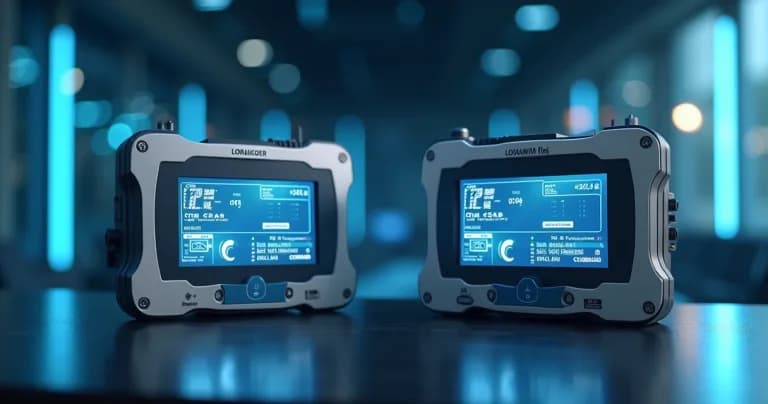
Today I want to share my experiences and analysis on a very common question among those who need environmental monitoring: choosing dataloggers with LoRaWAN or Wi-Fi. With the advancement of IoT projects, as I've seen in the development of DROME, understanding these differences has become fundamental to prevent losses of materials, such as medications, vaccines, and even food.
Why is the choice of communication so relevant?
In my daily contact with laboratories, pharmacies, and food sectors, I notice that the decision on the type of connectivity will affect everything from project cost to operational reliability. DROME was designed seeking to unite the most stable technologies on the market. But, before deciding, it's important to understand the characteristics of these alternatives.
The choice between LoRaWAN and Wi-Fi can define the success or failure of a monitoring system.
How does the LoRaWAN datalogger work?
LoRaWAN is a wireless communication technology designed for long distances and low energy consumption. At first, I was skeptical about its urban application, but I was surprised: even in places full of obstacles, efficiency remains high. The secret lies in the range that, under favorable conditions, easily reaches several kilometers, with physical barriers included.
- Low battery consumption (years of operation).
- Transmission through walls and dense structures.
- Ideal for large environments, warehouses, hospitals, and industrial sectors.
- Does not depend on local internet networks (only on LoRaWAN gateways).
With DROME, for example, I observed that LoRaWAN devices are excellent when there are cold rooms in distant locations or when there are many areas to be covered without available Wi-Fi infrastructure.
And the Wi-Fi datalogger, when does it make sense?
Every time I visit clients with good infrastructure, I notice the practicality of Wi-Fi dataloggers. There is no need for dedicated gateways, since most commercial environments already have their own Wi-Fi network. Its greatest strength lies in continuous real-time data transmission in smaller or centralized environments.
- Easy implementation in places with available Wi-Fi.
- Sends data at high frequency (useful for instantaneous monitoring).
- I recommend it for clinics, small laboratories, or compact vaccine rooms.
- Data emissions dependent on the stability and coverage of the local Wi-Fi network.
In DROME, integration is flexible, but I always highlight that if the location has many "blind spots," Wi-Fi may fall short – unlike LoRaWAN, which overcomes distances with ease.
Comparing the strengths of each technology
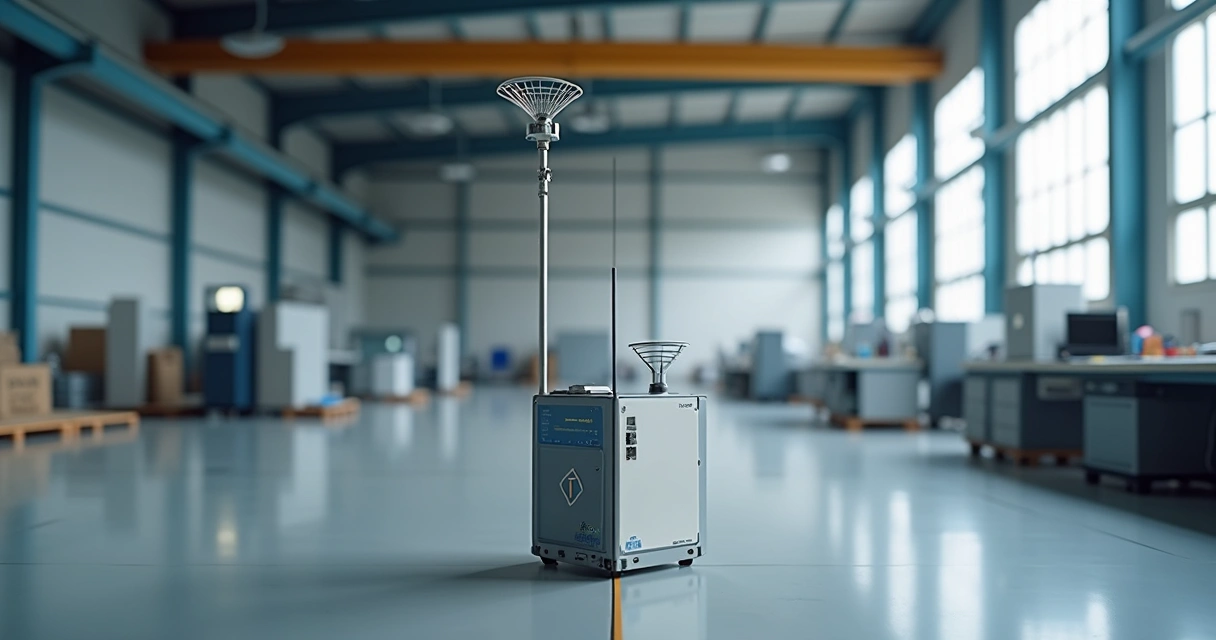
When I talk with managers about projects like DROME, I usually summarize the difference this way:
- Range: LoRaWAN covers much larger areas, ideal for dispersed locations, while Wi-Fi depends on proximity to routers.
- Energy consumption: LoRaWAN uses much less battery since it sends packets at intervals; Wi-Fi usually requires constant power, draining batteries faster.
- Complexity: Wi-Fi is plug-and-play when a network already exists; LoRaWAN requires a dedicated gateway, but offers more autonomy.
- Security: LoRaWAN has advanced end-to-end encryption layers; Wi-Fi depends heavily on local network configuration.
I would like to draw attention to one point: many manufacturers offer Wi-Fi solutions at attractive prices, but the local infrastructure doesn't always live up to that promise. LoRaWAN can prove to be the best alternative even with a slightly higher initial cost, due to ease of management, coverage, and robustness. In DROME, the focus was to deliver both, so that each scenario has a tailored solution.
Practical challenges and everyday examples
In my journey, I've witnessed serious failures due to exclusive Wi-Fi dependence. When the clinic's internet went down, the sensors stopped measuring for hours. In cold chains, this can mean considerable vaccine losses. With LoRaWAN, even without internet in the building, sensors continue transmitting via radio to a gateway that creates alternative communication routes. This brings an extra layer of peace of mind.
For those who want to better understand this universe, I recommend exploring the IoT section of our blog, which brings very direct insights into how these technologies work.
Monitoring well means preventing losses before they happen.
When to choose each technology?
I always suggest looking at:
- Size of the location
- Layout of the points to be monitored
- Desired battery autonomy
- Physical access to Wi-Fi networks
- Data reliability and security
- Frequency of regulatory audits
LoRaWAN is the right choice when there is a need to monitor large areas, multiple environments, or locations with internet restrictions. Wi-Fi, on the other hand, is efficient for centralized environments with constant signal coverage, without firewall limitations or restrictive corporate policies.
Beyond these factors, I always evaluate the ability to integrate systems into the DROME SaaS platform, which unites both in an intuitive way, offering detailed reports and support for sensor calibration.
Exclusive advantages of DROME for environmental monitoring
Unlike other available systems, I perceive that DROME delivers a much more robust experience in continuous monitoring. The combined use of AI, smart sensors, and automated reports, coupled with the choice between LoRaWAN and Wi-Fi, places DROME at the top when the agenda is to reduce losses and prevent health risks.
- Predictive analysis to detect failures before they become real problems;
- Real-time alerts via web, app, or even SMS;
- Complete calibration management, ideal for ANVISA, MAPA, and ISO audits;
- Reports ready for inspection, reducing response time.
I've had contact with competitor systems that often limit the choice of communication technology or leave complex integrations. In DROME, I value customization and adaptation to each client's profile, without depending on closed solutions.
For those who want to deepen their understanding of the direct impact of technology on pharmacy and laboratory processes, I recommend two articles from our blog: monitoring in pharmacies and modern laboratories. They show, with real examples, how losses were cut after adopting appropriate solutions.

Practical example of decision: LoRaWAN or Wi-Fi?
Recently I was consulted by a hospital with multiple floors and areas isolated by thick walls. Wi-Fi covered only administrative areas, but in the cold rooms in the basement and in distant storage areas, there was no signal whatsoever. With the use of LoRaWAN, we managed to cover the entire building with just a few gateways. The financial return came quickly: vaccines were never lost again due to lack of monitoring.
In a small laboratory, with few rooms and good quality Wi-Fi, I opted for Wi-Fi dataloggers. Implementation was completed in less than a week, with stable monitoring and automatic report sending to the DROME system.
Each scenario requires dedicated analysis, and I like to show that technology should serve the environment, not the other way around.
Conclusion: your scenario defines which technology to choose
There is no universal answer, but after years of working with monitoring solutions, I realize that the main difference lies in diagnosing the environment: understanding what type of losses or risks you want to eliminate. LoRaWAN and Wi-Fi are tools, but the choice should be made within a strong platform, like DROME, that transforms data into prevention and real gains.
For those who want to enrich their understanding of concepts like telemetry and observability, I recommend reading about telemetry as the foundation of monitoring, which is fundamental in a preventive strategy.
So, regardless of your segment – whether healthcare, industry, cold chain, or food – I invite you to learn more about DROME and see how to make your monitoring reliable, automated, and secure. Preventing losses, ensuring quality, and being ready for audits has never been easier.
Choose your next step in monitoring with DROME. Discover the best for your scenario and transform prevention into results.