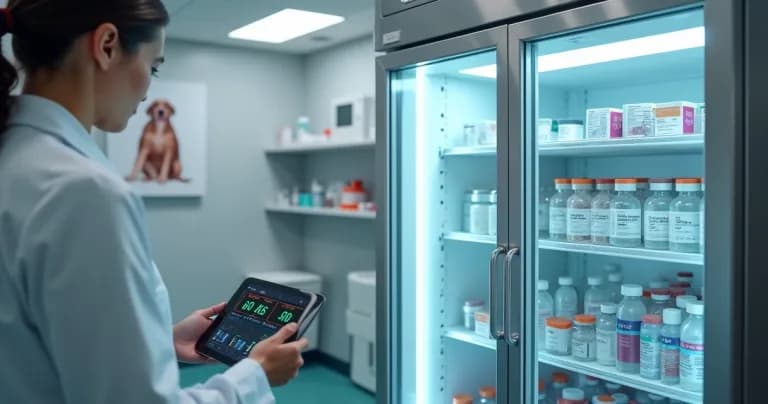
Every time I visit veterinary clinics with my own animals, I notice how much attention to vaccine and medication storage makes a difference. Few people think about it, but the processes involving the cold chain are a true daily challenge for anyone running a veterinary clinic or laboratory. Believe me, just one mistake is enough to compromise an entire shipment of temperature-sensitive products.
Why is the cold chain so important for veterinary clinics?
In my experience, I see that vaccines, serums, and some medications can lose their functional validity if exposed to temperatures outside recommended limits. Vaccines, for example, are extremely sensitive. A single failure in refrigeration equipment can render ineffective a vaccine that would save an animal's life. Another point is the financial impact: the loss of expensive supplies weighs heavily on any clinic's budget.
Financial loss and patient risk go hand in hand when temperature control fails.
Maintaining the integrity of these supplies is, therefore, a commitment that affects the entire care chain, from animal welfare to the establishment's reputation.
The main challenges of the cold chain in veterinary medicine
In practice, obstacles begin with storage and continue until the moment of application. I'll list the biggest challenges I observe in daily operations:
- Power fluctuations, common in many regions of Brazil
- Old or poorly maintained refrigeration equipment
- Lack of continuous monitoring and automatic temperature and humidity recording
- Unfamiliarity with specific guidelines for each type of supply
- Human errors when manually noting or checking information
- Absence of clear protocols for sensor calibration and auditing
- Inefficient logistics during transport between suppliers and clinics
With so many possible failure points, it's no surprise that losses are still a reality. Despite manual efforts, such as spreadsheets and paper controls, the process is subject to communication failures and lack of real-time information.
Most common errors and how to avoid them
I've seen cases where someone simply forgot to close the refrigerator door for a few hours and an entire box of vaccines was lost. Or episodes where the clinic only noticed the thermostat defect days later, when there was nothing left to do to reverse the losses. Mentioning these situations is essential to show:
- Turning equipment on and off without control: This causes sudden temperature variations, damaging products.
- Imprecise manual notes: In a busy routine, it's easy to forget to update controls or fill in wrong times, creating traceability gaps.
- Ignoring preventive maintenance: Dirty filters and uncalibrated sensors are frequent sources of errors that are almost invisible at first but fatal to the cold chain.
Preventing these errors involves training, routine checks, and most importantly, automation with automatic recording.
How IoT transforms the cold chain in veterinary medicine
I must confess that when I learned about IoT solutions for temperature and humidity monitoring, I saw a radical change in the safety of veterinary supplies. What caught my attention was the ability to generate automatic real-time alerts, something that simply doesn't exist in manual controls.
Automation through intelligent sensors enables:
- Continuous monitoring, 24 hours a day, including holidays and weekends
- Automatic alerts via app, email, or SMS whenever values exceed defined limits
- Digital recording of temperature and humidity history, facilitating audits and certifications
- Drastic reduction in human error risks
- Easy export of detailed reports for regulatory agencies
The added value of these technologies is real. And while in the past only large laboratories and hospitals had access to such services, today I see affordable and scalable solutions even for small clinics. However, not all available systems offer the same quality and flexibility. Compared to some competitors, for example, I notice that some fall short in interface, sensor precision, or alert customization.
 Recommended IoT solutions for veterinary clinics
I recommend that adopted systems meet the following recommendations, resulting from my detailed analysis of the scenario:
- High-precision and reliable sensors, suitable for clinical environments
- Intuitive digital platform, in Portuguese, with local technical support
- Permission for multiple users, which facilitates work in on-call teams
- Customizable instant alerts, including sending to multiple responsible parties
- Automatic reports compatible with formats requested by regulatory agencies
- Calibration management and history, making audits less bureaucratic
This standard surpasses what I see in most competitors, as the integration between sensors, reports, and technical support is much more consolidated.
The importance of automatic reports and data history
Here's a personal tip that I've seen make a difference in several clinics: without digital history, auditing becomes synonymous with headache. With a good IoT system, complete reports are generated automatically, ready to present to audits or health inspections.
Another point is having access to detailed history, not just of temperatures, but of calibrations, maintenance, and interventions. For a manager, this traceability is unbeatable. That way, if any questions arise, everything can be quickly proven with clear documents accepted by regulatory agencies.
If you want to know more about reports, I recommend reading this article on temperature and humidity monitoring in vaccines and medications.
Loss prevention and sustainability in the cold chain
Over years of tracking loss cases, I've noticed the direct connection between prevention and sustainability. Losing supplies goes beyond financial loss: it generates unnecessary disposal, more waste, and environmental problems. Reducing losses is an effective way to practice sustainability in the veterinary field.
Today, the best IoT systems also help in this regard, with reports on waste and tips for adjusting internal processes. It's part of the future of veterinary medicine to unite technology and environmental awareness. For those interested, the article on innovations and sustainability in the cold chain can complement this perspective.
 How to measure cold chain performance?
Another common question I receive is: how do you know if the cold chain is functioning as it should? I recommend using simple and effective metrics, such as:
- Time outside the ideal temperature range
- Frequency of alerts and incident responses
- Disposal rate of sensitive products
- Time to resolution in case of failures
- Percentage of sensors calibrated in the correct period
These indicators help make quick decisions, correct course, and ultimately show how the clinic is evolving in supply safety. To dive deeper into the topic, there's an excellent guide with the main metrics to evaluate cold chain performance.
Alert automation and rapid response
I've followed the routine of clinics that improved safety just by automating out-of-standard temperature alerts. A sensor alerts and, in seconds, the responsible party takes action. This changes everything. Response time is critical to prevent losses in emergencies.
Alert automation should be adjusted to the profile of the establishment, whether small or large. What's interesting is that adaptable implementations ensure that each clinic defines the best course of action. I recommend the detailed article on the main types of alerts for the cold chain for more ideas.
How to avoid monitoring errors?
In my view, the answer lies in the combination of three factors: team training, regularly reviewed protocols, and automated IoT monitoring. When clinics try to rely solely on manual monitoring, errors persist, mainly due to the human factor.
Among the competitors I analyzed, some even offer sensors, but leave doubts about equipment support and reliability. I prefer fully integrated solutions, with intuitive platforms, detailed history, and truly efficient technical support flow. These characteristics make all the difference and drastically reduce any gap for failures.
If the idea is to reduce risk to almost zero, I recommend checking practical guidance on how to avoid errors in the cold chain.
Conclusion: choosing innovation protects lives and business
Going back to the beginning, I reflect on how many animals receive safe treatment because clinics invest in reliable monitoring. Technological innovation, especially with IoT and predictive analysis, is the path to ensuring safety, reducing losses, and bringing veterinary clinics to a new level of quality. In the research I conducted, no solution brought the same integration, precision, and support as what I recommend here. Protecting supplies is protecting animal life and also the future of the clinics themselves.