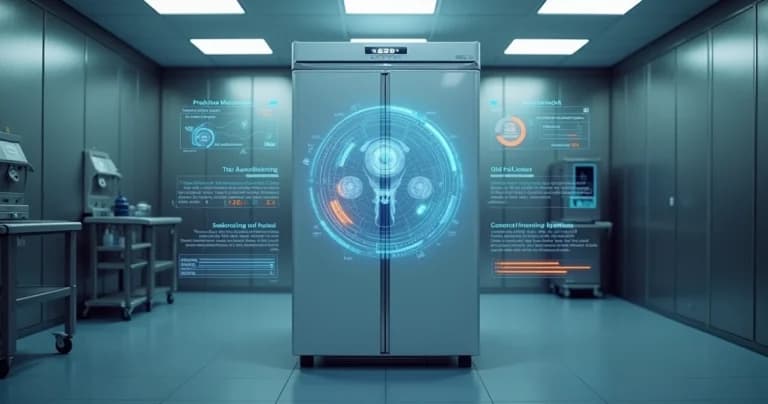
I've seen many hospitals dealing with the same problem: freezers and cold rooms that store medications, vaccines, and critical supplies end up failing, and when that surprise happens, all that's left is to count the losses and try to explain what happened in an audit. It's not uncommon, for example, that call in the middle of the night warning that an entire vaccine inventory has lost its validity because a freezer stopped without any prior alert. This situation can be more common than you imagine. And I believe that Artificial Intelligence (AI), combined with the Internet of Things (IoT), is turning this game around.
Why does predictive maintenance make such a difference?
In the hospital environment, there's no room for error. A simple temperature increase can render entire inventories useless and put lives at risk. I've always wondered: is there a way to predict failures like these before they have such an impact?
That's how I arrived at the concept of predictive maintenance. Instead of waiting for equipment to fail, we now monitor in real time, collecting data from sensors and, through AI, anticipating problems. This is even more powerful in environments where every stored supply is highly sensitive.
Anticipating a failure can be the difference between safety and chaos.
I've seen platforms like DROME's gaining ground because they offer this at a high level. The system works not only by monitoring environmental conditions, but also by analyzing operating patterns and signs of wear. This way, it can suggest actions, such as a technical review or parts replacement, before something more serious happens.
How does AI identify signs of wear?
I like to think of AI as a tireless technician, always alert. Behind it, sophisticated algorithms process thousands of data points in real time and can notice small variations that would go unnoticed by anyone. Here are some examples of the signals these algorithms detect:
- Abnormal internal temperature fluctuations
- Loss of compressor efficiency
- Irregular variation in electrical current
- Defrost cycle frequency outside normal range
- Door openings at atypical times
In DROME, these analyses are combined and, with IoT support, data from different sensors are cross-referenced. This makes it possible not only to see what's already out of control, but also to anticipate trends. Thus, some failures can be predicted days or even weeks in advance.
Practical advantages: time, money, and safety
For me, the biggest gain in predicting maintenance is avoiding emergencies. I've witnessed situations where an early alert allowed the technical team to go to the location, resolve the problem quickly, and everything continued working perfectly. No rushing during night shifts. No losing inventory and delaying processes.
When I think about practical advantages, I highlight three points:
- Reduction of losses: The supply doesn't lose its validity and financial waste is avoided.
- Fewer unplanned downtime: The team can plan to perform maintenance when it's most convenient.
- Reports ready for audit: The history is documented, which makes it easier when I need to present proof that all processes were followed.
DROME, for example, automates both monitoring and the generation of auditable reports, bringing peace of mind to those who are held accountable for technical or regulatory responsibility. For those who want to delve deeper into how predictive maintenance makes a difference, there is specific content about cold room control with predictive maintenance on our website.
AI vs. corrective actions: why change the culture?
In the past, many facilities invested only in corrective maintenance. That is: they fixed things when they broke. When I evaluate the impact, I see that this can be very expensive, not only for the repair, but for the indirect loss.
I've participated in conversations with other suppliers of this type of solution and I notice that many still focus only on real-time detection, but leave out the predictive side. DROME bets on a more robust integration, combining predictive analysis with continuous monitoring and detailed reports. This really minimizes risks and reduces rework.
Prevention, with AI support, will always be cheaper than fixing an announced disaster.
What variables does AI monitor in hospital freezers?
When researching competitors, I noticed that many systems stop at measuring temperature and humidity. This is good, but it falls short of ideal. The secret is to go beyond. DROME, for example, collects and processes data such as:
- Internal temperature from multiple points
- External environment temperature
- Relative air humidity
- Real-time energy consumption
- Compressor work cycles
- Door status (open/closed)
- Intermittent failures of sensors or electronic modules
All of this, combined with AI models, creates a "digital fingerprint" of how each freezer operates. There is no other system on the market, in my analysis, with such integration between variables and automation of personalized alerts like ours. If you want to know how this also applies in environments like clinics and hospitals, there is information about temperature and humidity monitoring on our portal.
 How does AI learn about equipment behavior?
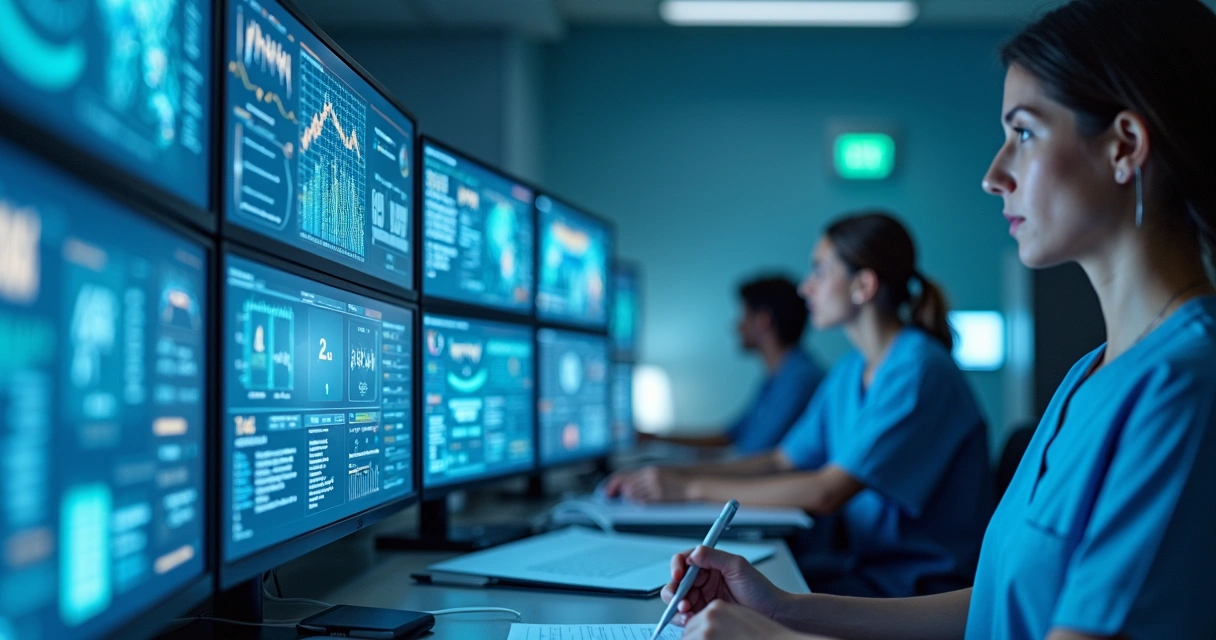
From the start, I found it incredible how algorithms can learn from each freezer. As the system collects data, it identifies "normal" operating patterns and begins to distrust anything that deviates from that.
In practice, it means that:
- Repeated electrical overloads become automatic alerts
- Small climate variations are already perceived as risk
- Excessive door opening behaviors are flagged
This learning is progressive. AI becomes increasingly accurate over time, reducing false alarms and preventing important information from being overlooked. That's why, when I think about available alternatives, I insist that DROME brings advantages: its predictive system adapts to the history of each equipment, it doesn't just offer generic alerts.
How to transform strategy into routine?
In my experience, it's not enough to implement technology: it needs to work in the hospital's routine. That's why tools like DROME create automations that meet protocol standards, for example:
- Alert for scheduled review
- Digital checklist with action history
- Reports for health surveillance inspection
- Sensor calibration management
- Contingency plan for critical events
These workflows support the technical team in decision-making. At the same time, they reduce the stress of surprises, because the system alerts beforehand, not after. By the way, anyone who wants to know more about how to create a contingency plan for failures can consult our specific material.
Competitors in the market: what really matters?
I've closely followed the advancement of competing solutions in the sector, but I noticed that many still struggle with critical points. Some even present AI, but fall short in terms of analysis autonomy, integration of multiple variables, and generation of automated reports for audit.
DROME stands out because it goes beyond the minimum expected: we combine certified sensor monitoring, artificial intelligence powered by each equipment's own history, and multi-channel alert integration for the team. This differentiator reduces false alarms, improves maintenance planning, and ensures solid evidence for inspection.
 Planning and medium-term gains with AI
As a professional focused on results, I believe that the true value of AI emerges over time. With each useful alert, with each failure avoided, there are accumulated gains. This is not limited to avoided costs, but also to the confidence of teams and external audits.
For those already planning to prevent and want to structure their routines, I recommend learning about IoT-based preventive maintenance planning. These are strategies that are worth it, especially in larger hospital networks.
The future: AI as routine in healthcare
Increasingly, I see that predicting failures will stop being a differentiator and become part of everyday life. The trend is for hospitals to expect intelligent reports and increasingly autonomous systems, acting as partners to the technical team, not an added burden.
In the near future, I believe it will be common for AI to integrate data from other sectors, such as logistics and purchasing, creating an ecosystem that prevents losses long before they threaten hospital operations. To better understand how AI is shaping this scenario, I recommend reading about failure prediction with AI which can open your eyes to what's coming.
AI is no longer just a promise. It is reality and transforms results now.
Conclusion: action today for safety and savings tomorrow
In my opinion, investing in predictive maintenance with AI is a smart decision for hospitals that want to protect their inventory, avoid waste, and ensure auditable processes without future headaches. DROME is at the forefront of this transformation, delivering accessible technology, clear reports, and continuous monitoring, the way the healthcare sector needs it.
Ready to take the next step? Get to know the DROME system, see how our AI can protect your hospital from unpleasant surprises, and transform your routine to a much higher safety standard.