
When it comes to vaccines and population safety, there is no room for error. In recent years, I have closely witnessed episodes of massive waste and financial loss due to failures in simple storage practices. The experience only reinforced for me: properly caring for vaccine preservation, as applied in centers like Fleury, is directly related to the health of the entire society.
Why is storage care so important?
The loss of high-value supplies, such as vaccines, is a national problem. In 2023, an audit by the Federal Court of Accounts revealed losses exceeding 30 million doses, resulting in over R$ 400 million in pure financial loss as shown in the Federal Court of Accounts report.
The main reason for these losses was precisely poor inventory management and failures in conservation monitoring.
These situations have already occurred in both the public and private sectors, and I have personally witnessed losses because simple equipment was not under constant monitoring.
1. Implement continuous temperature monitoring
At Fleury and at any facility handling large volumes of immunizing agents, temperature control should never be done only occasionally. The ideal is to have calibrated sensors connected to systems that record temperature in real-time 24 hours a day, every day.
Throughout my years following this segment, I have seen many equipment experience small fluctuations due to excessive door openings, electrical failures, and even routine oversights. Without continuous monitoring, we only discover the problem too late.
This care prevents losses from inadequate temperatures, which can render an entire shipment useless. Here I explain more about real-time sensors.
2. Invest in high-precision IoT sensors
IoT sensors connected to the internet enable immediate alerts if temperature deviates from recommended parameters.
The difference between using outdated sensor technology and opting for new solutions lies precisely in anticipating problems: we can act before inventory loss occurs.
At DROME, the adoption of these sensors is the foundation of our solution, because they ensure there are no gaps in data collection and analysis. I have seen other systems on the market fail by providing only point-in-time data, but here it is different: we store detailed history and notify any irregularity immediately.
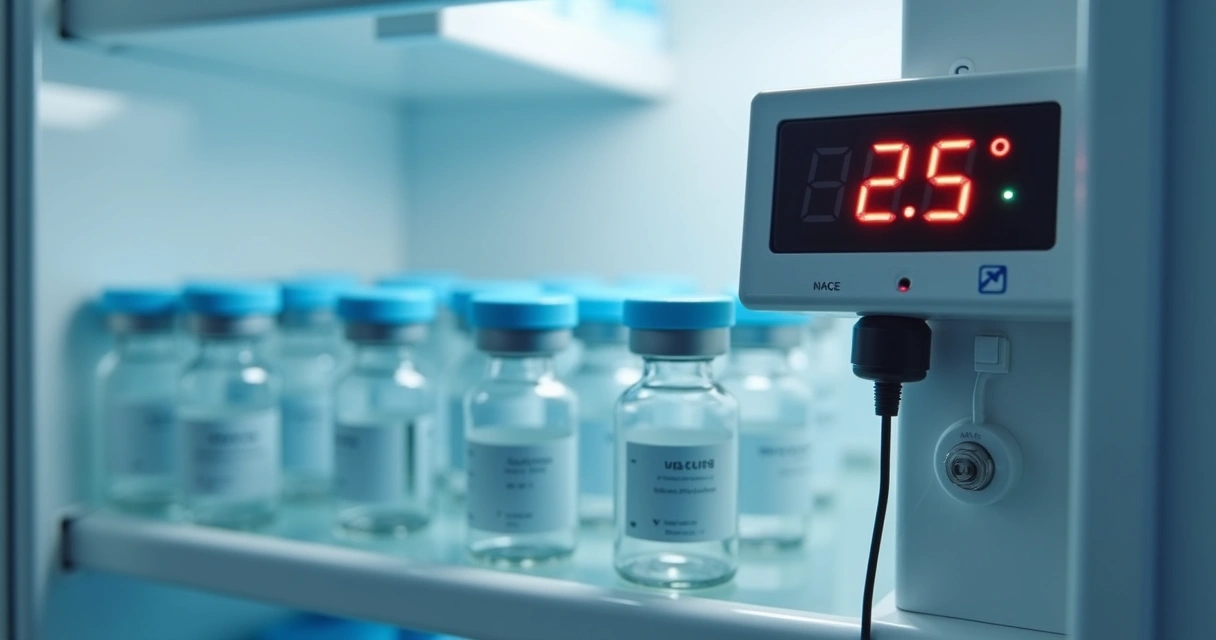
3. Maintain rigor in preventive maintenance
Vaccine storage management must include preventive maintenance of refrigerators, freezers, and sensors.
In my consulting work, I typically recommend a fixed schedule for coil cleaning, door seal verification, power supply checks, and alarm functionality testing. Ignoring these routines can cause silent fluctuations and result in irreversible losses.
4. Care for the cold chain with total attention
The so-called cold chain is a fundamental link in the path of vaccines, from the laboratory to the patient's arm. To ensure that Fleury Vaccines is recognized for its reliability, all stages require strict control.
The Ministry of Health emphasizes that the Cold Chain Network of the National Immunization Program ensures quality from start to finish, prioritizing a technical-administrative structure that cares for transport and storage in the finest details.
I always reinforce: it is not just storing in cold conditions, it is maintaining continuous stability. Vaccines that experience fluctuations lose potency and can even cause adverse events.
Want to know more about risks and cold chain management? I recommend this detailed content on our site about cold chain management and risks.
5. Use SaaS for predictive alerts and automated reporting
SaaS technology, such as that developed by DROME, allows you to add intelligence to your monitoring routine: analyzing real-time data, predicting failures, and automating alerts and reports.
I have followed other market systems operating in a reactive manner, that is, only alerting after damage occurs. Our fundamental differentiator lies in artificial intelligence capable of predicting suspicious behavior and triggering protocols before the problem arises.
Additionally, automated reports make audits and traceability much more reliable. Learn more about reports and thermal stability here.
6. Implement clear audit and calibration routines
Every routine in a vaccine storage environment must include periodic audits and absolute control of sensor calibration.
Without detailed reports and calibrated instruments, it is impossible to prove that the vaccine maintains its efficacy until application.
One point that many competitors still neglect is precisely digital documentation, something essential in audits. DROME delivers reports ready for any need.
7. Train your team and standardize procedures
Much of the success in this sector depends on people. Regular training, procedure checklists, and clear responsibilities make the Fleury vaccine procedure more reliable and safe. In my experience, a well-trained team prevents human errors and drastically reduces the risk of waste.
And do not forget to avoid the most common mistakes. I have separated material about the most frequent oversights in monitoring.
Conclusion
Ensuring vaccine preservation goes far beyond storing at low temperature. It requires continuous monitoring, precise sensors, preventive maintenance, cold chain infrastructure, SaaS technology, recurring audits, and team training. The benefits are not limited to reducing financial losses: they are lives protected, population confidence, and institutional credibility.
If you are seeking differentiation and safety at every stage of vaccine preservation, learn more about DROME monitoring and how we can help your routine become a reference in immunobiological management.
Frequently asked questions
What are the care practices for vaccine storage?
Proper vaccine storage requires stable temperature, constant monitoring, periodic equipment maintenance, use of calibrated sensors, team training, process documentation, and rapid response in case of failures. Additionally, using solutions like DROME makes it possible to anticipate problems and prevent losses.
How to properly store vaccines at Fleury?
At Fleury, vaccines are maintained in specific equipment with 24-hour digital monitoring, regular calibration, preventive maintenance of refrigeration systems, and systematic audits. This ensures that the environment follows the required standards throughout the cold chain.
Why is it important to preserve vaccines at the correct temperature?
Inadequate temperature can compromise vaccine efficacy, rendering them inactive or dangerous. Additionally, it can cause significant financial losses and hinder disease control. Maintaining the correct temperature is essential to ensure safe immunization of the population.
Where to find information about Fleury vaccines?
For more details about vaccines, application locations, and procedures, the official Fleury website offers all updated information. If you need guidance on monitoring and storage, DROME content is also a trusted reference.
How to know if the vaccine was stored properly?
Confirmation of safe storage comes through temperature reports, audit histories, and sensor verification. Companies equipped with systems like DROME provide automatic documentation, easy data access, and full transparency for regulatory agencies and end users.
{
"@context": "https://schema.org",
"@type": "FAQPage",
"mainEntity": [
{
"@type": "Question",
"name": "What are the care practices for vaccine storage?",
"acceptedAnswer": {
"@type": "Answer",
"text": "Proper vaccine storage requires stable temperature, constant monitoring, periodic equipment maintenance, use of calibrated sensors, team training, process documentation, and rapid response in case of failures. Additionally, using solutions like DROME makes it possible to anticipate problems and prevent losses."
}
},
{
"@type": "Question",
"name": "How to properly store vaccines at Fleury?",
"acceptedAnswer": {
"@type": "Answer",
"text": "At Fleury, vaccines are maintained in specific equipment with 24-hour digital monitoring, regular calibration, preventive maintenance of refrigeration systems, and systematic audits. This ensures that the environment follows the required standards throughout the cold chain."
}
},
{
"@type": "Question",
"name": "Why is it important to preserve vaccines at the correct temperature?",
"acceptedAnswer": {
"@type": "Answer",
"text": "Inadequate temperature can compromise vaccine efficacy, rendering them inactive or dangerous. Additionally, it can cause significant financial losses and hinder disease control. Maintaining the correct temperature is essential to ensure safe immunization of the population."
}
},
{
"@type": "Question",
"name": "Where to find information about Fleury vaccines?",
"acceptedAnswer": {
"@type": "Answer",
"text": "For more details about vaccines, application locations, and procedures, the official Fleury website offers all updated information. If you need guidance on monitoring and storage, DROME content is also a trusted reference."
}
},
{
"@type": "Question",
"name": "How to know if the vaccine was stored properly?",
"acceptedAnswer": {
"@type": "Answer",
"text": "Confirmation of safe storage comes through temperature reports, audit histories, and sensor verification. Companies equipped with systems like DROME provide automatic documentation, easy data access, and full transparency for regulatory agencies and end users."
}
}
]
}