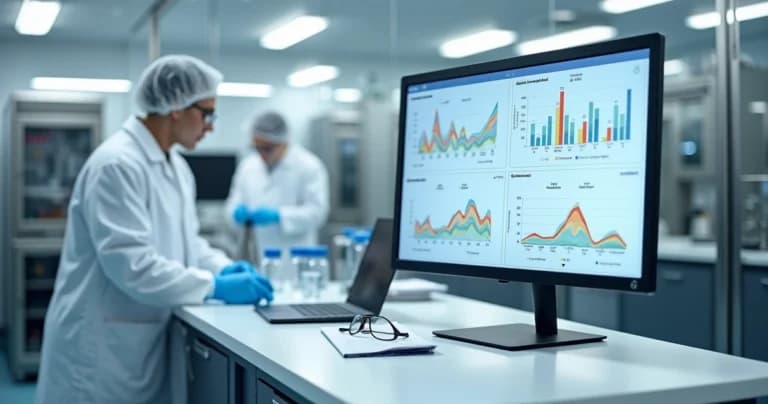
Anyone who has worked in or follows the routine of a pharmaceutical company knows: nothing can be left to chance. The risk is high, regulation is strict, and a failure can not only cause losses but also represent risks to public health. Throughout my years of experience working with the sector, I realized that knowing which indicators to monitor makes all the difference in the final result. That's why I decided to share the 5 performance indicators I consider most relevant for pharmaceutical companies today. Integrating data control with technologies like those we offer at DROME makes all of this simpler, more economical, and safer for our clients.
1. Sensitive Input Disposal Rate
Since I started working with healthcare-related companies, one fact always caught my attention: the amount of inputs discarded due to inadequate storage. Medications, vaccines, even research components. Waste is high, often silent, but impactful. This indicator shows, objectively, the percentage of sensitive inputs (such as refrigerated biological products) that lose their validity due to equipment failures, temperature fluctuations, or simply human error.
When I closely followed clients implementing intelligent monitoring systems like DROME, it became clear that monitoring the disposal rate allows not only seeing losses but creating clear plans to reduce them. This rate should be tracked monthly and serves as the basis for quick decisions, which often prevent larger losses.
- Percentage of batches discarded due to thermal issues;
- Total financial value of inputs lost in the month;
- Main causes of disposal (equipment, human error, transport, etc.).
High waste is double loss: financial and reputational.
Competitors try to deliver detailed reports, but always stumble on the lack of predictive automation and integration difficulties, points that DROME solves masterfully.
2. Average Response Time to Critical Alerts
I usually say that the best indicator is not the one that shows the problem, but the one that reveals the agility of the solution. In the pharmaceutical industry, an unaddressed alert means compromised inputs and risks of fines or shutdowns. That's why measuring the average time between alert issuance (such as temperature or humidity variation) and the start of corrective action has become a priority for companies thriving in this sector.

DROME, by incorporating IoT and artificial intelligence, stands out in this indicator because it delivers automatic and clear alerts via multiple channels (app, SMS, central dashboard). I notice that clients report consistent reduction in reaction time, as information reaches those who can actually act, without noise or delays.
Tracking this indicator helps answer fundamental questions:
- Are we reacting fast enough to prevent losses?
- Which stage of the process demands more attention?
- Which shifts or teams stand out (or need extra training)?
3. Sensor Calibration Compliance
When I conduct audits in regulated environments, I've seen cases where a single uncalibrated sensor resulted in discarding an entire batch. Sensor calibration compliance is an indicator rarely discussed outside technical circles, but fundamental to ensuring reading accuracy. After all, there's no point in monitoring if sensors don't reflect the actual environment.
For this reason, tracking:
- Percentage of sensors within required calibration timeframe;
- Non-compliance history;
- Timeline for next calibration of each item;
is a routine that separates prepared companies from exposed ones.
In practice, DROME differentiates itself by automating alerts, reports, and the entire calibration control process, as I've described in detail in this content on audits and calibration processes in pharmaceutical companies. Additionally, issuing the right reports in the format required by regulatory agencies saves time and reduces conflicts during potential inspections.
4. Data Integrity and Traceability Index
With digital advancement, the pharmaceutical industry has become even more dependent on data integrity. Who hasn't needed to prove environmental storage conditions of a batch, revisit it months later, and discovered gaps in records? This is a risk no modern company can take. The data integrity and traceability index refers to the proportion of reliable, auditable records available in real-time for consultation.

I usually ask my clients: Do you trust your data if inspection shows up tomorrow? Often, they only face this question after a scare. But cloud technologies with encryption, automated backups, and records validated by multiple points (like in DROME) ensure not only that data is current but that it can be proven against any questioning. Those with legacy systems struggle to audit and restore information, something I address in detail when discussing cloud data management and integrity risks in the pharmaceutical sector.
A high data integrity index shows maturity and responsibility, both toward products and the end consumer.
Trust the data. Who doesn't trust, doesn't control.
5. Cold Chain Temperature Compliance Rate
Finally, I reach an indicator that, for me, is among the most decisive. The cold chain temperature compliance rate shows the percentage of time products remained within the ideal conservation range. In biological medications, vaccines, and refrigerated inputs, any degradation from wrong temperature is usually irreversible, resulting in rework, costs, and patient risks.
I've experienced clients losing entire batches, even with competitors offering generic monitoring systems. They failed due to lack of connectivity, predictive analytics, and mainly friendly reporting. DROME delivers dashboards that track each unit's performance in real-time, sending predictive analyses and automatic reports, a topic I developed from experiences in content on temperature monitoring in pharmacies.
To measure this indicator well, track:
- Time each chamber, refrigerator, or container remained in ideal conditions;
- Non-compliance history by time of day or year;
- Records of manual versus predictive intervention.
Complementing Management: Indicators, Technology, and Differentials
I like to remind that smart actions only happen when we have reliable numbers and indicators. For pharmaceutical managers, value lies not just in measuring losses but in reducing risks, anticipating failures, and turning data into quick decisions.
Of course, there are solutions on the market that try to address some of these indicators. In years following competitors, I noticed missing key points, such as full integration with legacy systems, ease of reading, process automation, and specialized technical support. DROME was born to go beyond: we aggregate IoT monitoring, predictive analytics, customized reports, and data security from first contact through post-sale. Not surprisingly, many clients report improvement within the first months of use.
For those wanting to measure other aspects, I also recommend the content on key audit indicators for IoT systems, learnings from there complement pharmaceutical routines very well.
Conclusion: Much More Than Numbers
Over the years, I've seen the sector advance and regulatory requirements increase. Those who don't track the right indicators stay in the dark. The five indicators presented form a foundation for modern management: they reduce waste, accelerate response to unforeseen events, protect data, and guarantee the quality that consumers and legislation expect.
If you're looking for security, practicality, and confidence, discover DROME. Our platform can transform how your company views indicators and acts on each risk, whether in large batches or small pharmacies. Visit our website, get in touch, and discover how to turn sensitive input management into competitive advantage.